
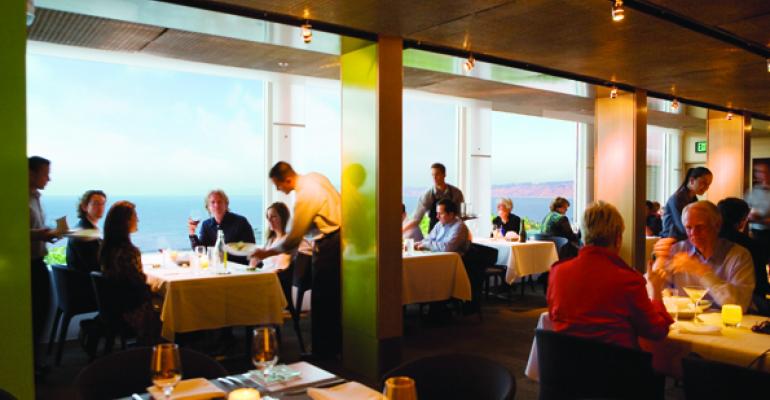
Trey Foshee navigates a lot of waves as executive chef and partner at George’s at the Cove. This La Jolla, CA, seaside institution houses three restaurants: California Modern, Ocean Terrace and George’s Bar. Ever on the lookout for ways to keep George’s at the top of its game, Foshee most recently rolled out three new “dining experience” menus spotlighting local ingredients at the sophisticated California Modern. Foshee spoke recently about the demands of a high-volume operation and how the San Diego dining scene is evolving.
With three restaurants, you must be very organized.
We call it one restaurant, but it’s really three concepts with a fair amount of crossover. The upper floor and middle floor share the same menu, more California bistro, what you would expect for a restaurant on the water: entrée salads, a lot of fish, everything simple and seasonal, uncomplicated presentations. Downstairs is California contemporary cuisine, more plated.
We have about 380 seats. During the summer, we serve 1,000-1,200 meals a day.
• Kentucky Pye cocktail recipe from California Modern at George's at the Cove
How do you produce that kind of volume and keep the show running smoothly?
When you think in terms of overall volume, it seems super big, but it’s divided up in an intelligent way. And we have a good amount of management involved in operating each level. At the front of the house, for example, we have an assistant general manager for each level, and each of them has an assistant manager. There’s very little crossover, so they really take ownership of their floor. It’s the same way in the kitchen. We have a chef de cuisine on two floors. It’s really like running two restaurants under one roof.
George’s occupies such an iconic location. What are some ingredients that say “Southern California” to you?
What grows here also grows elsewhere, it’s just that we have a longer growing season. We have tomatoes, corn and zucchini, just like everywhere else. But here, all that produce is picked in the morning, brought to the restaurant and used that day. A lot of our stuff never sees the refrigerator. More than anything that has a huge impact on the quality of the product.
We have seasonal products as well. During the main season for California avocados, we use a lot of them. We have avocados everywhere on our menu. About 90 percent of the avocados grown for us are from California, a large number of them from nearby. The quality of California avocados is far superior to any that you get from elsewhere.
When it comes to seafood, in San Diego you think of spot prawns, sea urchins and spiny lobster. But Asian countries have been buying most of our product the last few years and pricing us out of the market.
Do you consider certain dishes on the menu essential to your identity?
At California Modern, not as much. We change the menu a lot and people expect to see new and seasonal stuff. Upstairs it’s a little different. We change a bit less often, and people get attached to certain items. For instance, when halibut is in season, we have people calling to find out when it will be on the menu. It’s a super-simple dish, but people do back flips over it. We serve it with local corn and cherry tomatoes. It’s the same with fish tacos. We’ve had them on the menu since before I joined the restaurant. We sell about twice as many fish tacos as the next highest selling item. I can’t imagine changing those or taking them off the menu.
How the business has changed
For California Modern, you created a deconstructed version of that taco that has generated a lot of attention. What inspired that idea?
The restaurant community has grown a lot since I arrived in San Diego. But many people still say that when they think of San Diego, food-wise, they think fish tacos. That is something we should be celebrating. We are in San Diego. It’s fish taco land. So I looked at the grilled fish tacos that we serve upstairs and started thinking about an upscale version.
I was working on it without success, but then I went to Baja California. Eating fish tacos down there, traditionally they batter and fry fish. I started thinking about a Baja-style fish taco and taking the elements apart. I looked at the list and said we can put all these things on a plate in a variety of ways. Why not turn the fish part into a shell? What about using corn nuts instead of the corn tortilla? So I turned raw yellowfin into the “tortilla” and crusted it with corn nuts. Then I figured we needed something breaded and fried, and the avocado was missing, so we said let’s bread and fry that.
You’ve been here since 1999 and before that at a number of prominent West Coast restaurants. How has the business changed?
One big change is the area of sustainability and the responsibility that chefs have to understand where their products are from and how they are raised. When I was a young cook we didn’t need to know anything about that. We were concerned about what tasted great and what fit the style of the restaurant, and that’s it. Now you are forced to ask whether you are using that beef just because it tastes good or because it’s a healthy, well-managed product. I think that’s a positive.
The second thing I’ve seen is a change in the type of people looking at the kitchen as a career. It sounds cliché, but when I was younger, this was not a profession that was highly respected. Maybe if you got a job at certain restaurants people would say “wow!” But with the media attention, and with people genuinely more interested in food, there’s a big difference. People coming into the business sometimes have a less clear understanding of what the industry is. Some people think it will be all about creativity, and they kind of glorify it. Then they see the reality of it. Other people see it as a brutal business and take pride in it and see it as an art form.
There are a lot of hard-working young cooks out there. I think they are more knowledgeable and more educated about what’s going on in the industry. They come into it with an agenda and know they need to develop certain skills. When I was coming up I happened to find myself in a good restaurant. I didn’t know what I was going to do in five years.
With a spectacular location like yours, many operators would go on culinary cruise control. But you haven’t.
I am one of three owners, and we are constantly trying to improve what we do. Yes, we have a location that would allow us to pretty much rest on our laurels and not work that hard. But we are constantly trying to improve the service, food, beverages, where we get our products. It’s something we think about every day. George’s has been around a long time, and it keeps getting better.


