
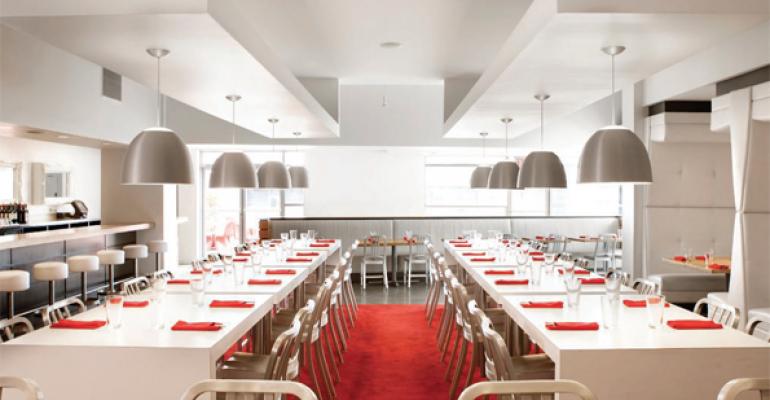
John Brandt-Lee, chef-owner at Avalon Restaurant in West Chester, PA, faced a dilemma. Customers felt so comfortable at his intimate BYOB concept that they would settle in for the evening, limiting the revenue his 40 seats could generate.
“We needed the tables to turn—but for customers not to feel as though we had dropped a check with their dessert,” he recalls.
His answer was to adopt a small plates format. Food runners started hustling the antipasti items family style out of the kitchen as soon as they were ready. Individual entrees went out next. The runners efficiently cleared tables, giving servers more time to take orders and interact with guests elsewhere in their stations without unnecessary trips back to the kitchen.
The experiment has been a success. It’s shaved half an hour from the time it takes to service a four-top. It also hasn’t alienated the guests. “The social interaction and constant staggered ebb and flow at the table gives the customers the feeling that it is part of the experience and not a rushing tactic,” Brandt-Lee says.
There are countless ways to speed up a restaurant’s service sequence, starting with the initial order and ending with presentation of the check. Here are seven ideas for ways to get it done faster.
1. Don’t skimp on staff.
Many restaurant owners, looking to save a few bucks on labor, stretch their servers, runners and bussers too thin. “We offer our service team smaller sections to ensure efficient, high-quality service, even at peak hours,” says Laura Payne, g.m. at Chicago’s Purple Pig.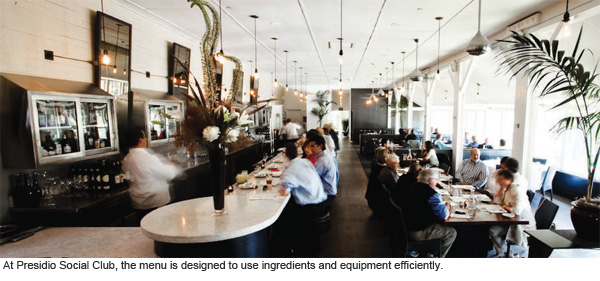
That’s a smart strategy, according to Fred LeFranc, founding partner of Results Thru Strategy, a Charlotte, NC-based company that has fine-tuned a number of restaurants and chains. He advises clients to focus on productivity—sales per hour or guests per hour. Beefing up staff, giving them goals, creating smaller stations and staffing up behind the scenes are steps that often boost productivity well beyond the additional labor costs.
2. Help your guests to help themselves.
The more time a server spends at one table, the less time he or she has to help another party. That’s not a problem at a destination restaurant where guests plan to spend several hours, but the average operator needs to turn tables. Why put stumbling blocks in the way of an order?
For instance, is your menu clever—or is it functional? “You have to decide if you are the type of restaurant that can do three-word descriptions or if you need a sentence or two. At a lower price point, you probably want to provide more information so the guest can order quickly,” says Frank Klein, a foodservice consultant based in San Francisco.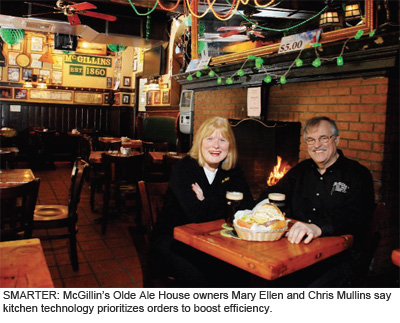 Wine lists can require time-consuming consultations as well. Klein suggests providing tables with iPad wine lists with detailed tasting notes, printing a short description after each wine or simply listing wines in order from light to robust, or dry to fruity, to help steer guests.
Even a simple gesture, like leaving a pitcher of water on the table, can save a server or busser time and steps.
3. Take a strategic approach to menu design.
Streamlining a menu is a good way to speed up orders.
“You need to look at the complexity of the menu and how many ingredients are in each of those items,” says Shelia Turner, v.p. of restaurant operations and marketing for the Puccini Group, which manages San Francisco’s Presidio Social Club. “The more ingredients, the more difficulty you have in getting it out of the kitchen, and the more items you need to maintain on the line.”
Thinking about equipment is another key to streamlining the preparation process. “Match the menu to the kitchen equipment that you have,” Klein suggests. As your menu evolves, consider different equipment to match it. And it’s important to update your POS system as your menu changes as well, so your servers won’t need to spend extra time hunting for current items. “Sometimes there are ‘ghost’ items just sitting there taking up space and confusing everyone,” Turner says.
Guests like tapas and other small plates because they are fun; many owners and chefs like them because they are fast and can be served immediately rather than according to the traditional app/entrée/dessert pattern.
See more tips from operators
4. Stay in touch.
In an efficient restaurant, the front and back of the house need a way to talk during service.
LeFranc says communication is the only way to ensure that restaurants follow what he calls “the two-minute drill”: making sure no table is allowed to sit vacant for more than two minutes. Insisting on that kind of turnaround requires communication between the servers and hosting staff. A motivated server will be more likely to make sure tables in his/her section are occupied.
Jill Barron, executive chef and owner of Mana Food Bar in Chicago, credits constant contact with a smooth operation. “We have ‘on the fly’ and other written triggers that the servers use to prompt their service. When the kitchen starts getting slammed, the expeditor communicates that to the front-of-house manager, who checks and relays priorities,” she says.
Signals work for some. At Great Beginnings Café in Englewood, CO, guests being seated are asked for drink orders; the host or manager uses sign language to share the order with the server, who might be across the room.
Sometimes staying in touch is a matter of asking employees for solutions. “With 90 percent of the problems, employees have the answers,” LeFranc says. “If you tell them that guests think service is too slow, and ask them what the barriers to speeding it up are, they might say ‘we don’t have enough silverware or plates,’ or ‘the bartender is too slow.’ You just have to get them involved in the process.”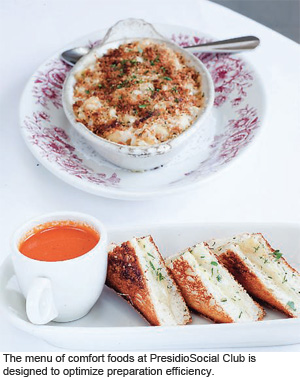 5. Be prepared.
Smart operators get creative about advance prep.
A popular bar, for example, is fantastic—unless it ends up being a bottleneck. Adam Seger, mixologist at Hum Spirits Company in Chicago, suggests selling batch-mixed drinks as a hedge against gridlock. “Batching craft cocktails like punches using fresh ingredients is a great way to serve a beautiful cocktail quickly and efficiently without slowing down service with muddling and building drinks to order,” he explains.
When it comes to food, some operators consider sous vide a godsend. “We sous vide our chicken, lamb and duck ahead of service so cooking time on the line is faster during service,” says chef/owner Carl Thorne-Thomsen of Chicago’s Story restaurant. He says the process saves four to six minutes per dish.
McGillin’s Olde Ale House in Philadelphia uses technology to expedite orders. A QSR screen prioritizes orders so the cooks start the items that take longest to cook first, followed by quicker items. Owner Chris Mullins, Sr. says the system has yielded better accuracy and made for a quieter kitchen. It’s also shaved lunch service time by five minutes per order—which adds up on a busy day, when there might be 250 covers.
6. Consider changes to layout and design.
Dan Maas, a principal at ai3, Inc., an Atlanta-based design firm with clients like Top Chef’s Richard Blais and James Beard honorees, says layout is a powerful tool to boost efficiency.
One key connection that many restaurants fail to make is the greeter/floor manager and the kitchen, Maas says. The kitchen needs to be able to convey when it’s in the weeds and cue the greeter to ask incoming guests to chill at the bar so the staff can catch up. If that can’t be done physically, it needs to be done with a radio or other communication device.
Maas also advises laying out a room to avoid bottlenecks at the POS and beverage stations. And he’s a fan of dividing rooms into smaller spaces, which force the servers to circulate more and check up on guests—preferable to a larger room with servers standing around monitoring the situation.
Lighting is another small but key factor in efficiency. “You don’t want to ruin the ambiance or any design aesthetic you are trying to achieve with lighting, but at the end of the day, you have to be able to read the menu,” Maas says. Otherwise the server will need to help guests read it. He suggests local lighting.
Furniture is another area that can have a subtle impact on speed of service—or at least of dining. Metal chairs without backs do not encourage guests to linger; comfy leather booths, on the other hand, do.
7. Insist on vigilant managers.
LeFranc says many managers don’t understand the nuances of service. He suggests having managers shadow servers so they see the dynamics, the cues and so on. That knowledge will help them manage the flow and intervene when necessary to speed things along.
Service involves many stages, and too often a restaurant staff does everything well—up until the end. We’ve all experienced the “I’ve had dinner, dessert and coffee. Where the heck is the check?” moment, Turner observes. Forgetting to present the check and collect payment not only frustrates the guest but misses an opportunity to turn over a table. Training and an on-the-ball manager will help avoid that kind of lapse.


