
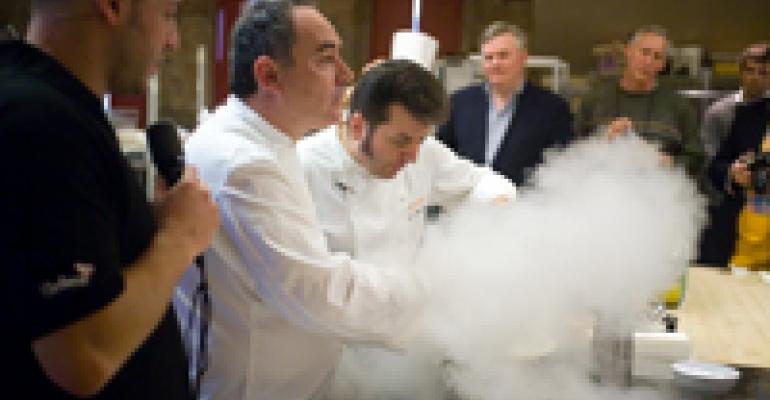

Like to tinker in the kitchen? Wondering if the taste, textural and temperature manipulations pioneered by culinary alchemists might work on your menu or otherwise help you advance your career? Your time has come with the release of Ferran Adria’s A Day at El Bulli book and his $200 starter set of commercial food additives and techno cooking gear. You might think his cuisine is goofy, but Adria is widely regarded as the world’s best chef and El Bulli is consistently ranked as the best restaurant in the world. Now that information about this style of cooking has become more affordable and accessible, why not give it a try?
We aren’t making the case for molecular gastronomy here, only noting that learning about it has suddenly become much easier. To further underline its importance, we would point out that its foremost practitioner in the U.S., Grant Achatz of Alinea in Chicago, has in short order taken home James Beard Awards for Rising Star Chef, Best Chef Midwest and Outstanding Chef. When the people at the very top of their profession have gotten there by doing something much different than anyone else, that something is worth exploring by everyone else, or at least by those who want to broaden their repertoire and embrace the new.
However, the venues in which you might explore molecular gastronomy are few and far between. You can’t go to the Culinary Institute of America and major in it. The 142 videos on YouTube (search “molecular gastronomy”) have little instructional value. Your best shot is to score a stage with Adria or Achatz and observe them in their labs and kitchens (they’ve got both). Barring that, you’re on your own.

But both these chefs readily give away some of their secrets if you’re willing to buy their books. Adria has published his collected work—more akin to a notebook detailing lab experiments than a classic recipe-driven cookbook—five times. His books document his food experiments from 1983 on. Some are printed in English, others just in Spanish and Catalan. Each costs several hundred dollars, with the most recent sporting a $325 list price.
From a cost and learning standpoint, you might be better off if you approached molecular gastronomy in a different way.
First, buy a copy of Adria’s 528-page A Day at el Bulli (Phaedon, $49.95). You can get it as cheaply as $32.97 on Amazon; it costs $39.96 at Barnes and Noble. This one’s not a cookbook per se, either, nor is it a comprehensive log of the author’s many, many culinary experiments. But it still includes a decent number of diagrams, recipes and instructions about how to concoct many of the items that go onto El Bulli’s 30-course tasting menu each day.
If you’re feeling flush, you could also spring for Achatz’s first cookbook, Alinea (Ten Speed Press, $50). It contains 600 recipes and Achatz goes in-depth on 10 key techniques. If you need a further visual reference, you could throw Anthony Bourdain’s DVD Decoding Ferran Adria ($30) into your shopping cart, too.
Then it’s time for one more shopping excursion. If you’re willing to part with $200, head to www.deandeluca.com and order a Texturas Spherification Minikit. Here’s the sale pitch:
“Margaritas with Salt Air. Feta Water Fettuccine. Mojito Gelification. Parmesan Eggless Egg. Now you can create all of these fantastic foods in your home kitchen with the Spherification MiniKit from Texturas. This kit comes with everything you need to create hot and cold gelatins, produce ultralight textures and transform your favorite flavors into spheres of different sizes (think caviar, marbles and eggs).”
Included are five items that let you control the shape and texture of liquids: 3.5 ounces each of Gluco, Algin, Xantana and Agar; 2.4 ounces of Lecite; three tools; plus an instruction/recipe booklet.
That’s not much for $200. Alternatively, you could head to chef Will Goldfarb’s www.willpowder.net and get his Willpowder Pantry kit for $46. That gets you two ounces each of lecithin, egg white powder, tapioca maltodextrin, agar agar and xanthan gum. Many other molecular gastronomy products are available singly and as part of packages at this site. You’ll also find a handful of recipes with good instructions—note that we’re not saying “easy to follow” instructions.
third source is www.le-sanctuaire.com. Check out the “Molecular” or “Texture Modifiers” categories to access a wide range of cutting-edge ingredients. Both willpowder.net and le-sanctuaire.com offer better pricing on restaurant-sized packs of most items.
Is molecular gastronomy for everyone? No, but it might have more applications for the amuse-bouche, appetizer and dessert sections of your menu than you might think. With a modest investment of time and money, you can explore it for yourself. How far you get will be up to but you; have to admit it has worked well for Adria, Achatz and their restaurants.


